

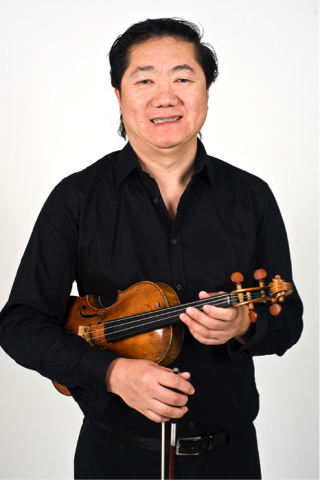
Bin Chao nasceu no seio de uma família de músicos e começou a tocar violino aos seis anos de idade. Poucos anos depois, foi selecionado nas audições nacionais para estudar no Conservatório Central em Pequim. Diplomou-se com distinção e foi então convidado a integrar o corpo docente do Conservatório Central de Música, onde foi igualmente concertino na Orquestra do Conservatório. Concluiu um Mestrado em Música no Mannes College of Music de Nova Iorque, onde estudou com o violinista David Nadien. Participou também nos cursos de aperfeiçoamento de Gerard Poulet e Robert Mann.
O violinista e crítico musical Henry Roth elogiou a musicalidade forte e a técnica sólida de Bin Chao no seu livro “Grandes Violinistas.”
Em 1984, Bin Chao foi 2º classificado e recebeu um prémio para “Melhor Interpretação” no Segundo Concurso Nacional de Violino da China. No mesmo ano, fundou o Quarteto Beijing que, sob a sua orientação, ganhou o Concurso Nacional de Música de Câmara, apresentando-se em seguida por toda a China, a convite do Governo Chinês, o que lhe granjeou maior notoriedade junto da elite chinesa. Como resultado da sua proeminente realização na música. o governo de Beijing atribuiu-lhe o “Prémio de Músico Notável.”
Como solista, atuou com as mais importantes orquestras chinesas. As suas numerosas atuações na rádio e na televisão tornaram-no uma celebridade a nível nacional. Desde que se mudou para Lisboa, em 1991, atuou por toda a Europa, na América do Norte, no Japão, em Macau e Hong-Kong. Participou em muitos festivais de música, incluindo os Festivais da Madeira, dos Capuchos, do Algarve e de Évora, em Portugal, o Festival de Aspen e o Festival Schumann de Nova Iorque, nos E.U.A. Desde 1993, Bin Chao é concertino auxiliar da Orquestra Gulbenkian. Entre 1997 e 1998, acompanhou a Orquestra Gulbenkian em digressão à China, tendo interpretado o Concerto para Violino de Tchaikovsky, atuação difundida, em direto, pela televisão nacional chinesa.
Apresenta-se também regularmente com o Quarteto Capela, com o qual realizou várias digressões internacinais.
Bin Chao é também um maestro requisitado por orquestras no Oriente e na Europa, nomeadamente a Orquestra Gulbenkian, a Orquestra Filarmónica de Cantão, a Orquestra da Universidade de Évora, e a Orquestra Estela Ensemble, entre outras.
Ao longo da sua vida profissional já tocou mais de 30 concertos para violino e Orquestra. Gravou para a Estela Ensemble 6 DVDs com reportório clássico, que incluem música de câmara e para violino solo, incluindo As Quatro Estações de Vivaldi e Piazzolla.
Apresenta-se com frequência no Lincoln Center, no Carnegie Hall, em Riverside Church e Goethe Institute, em Nova Iorque.
Entre 1999 e 2001, ensinou violino nas escolas públicas de Nova Iorque como parte de uma iniciativa da Fundação Midori.
Integrou o quadro de professores da Universidade de Évora entre 2001-2007, onde ensinou violino, música de câmara e viola. Desde 2007, ensina violino e música de câmara no Instituto Piaget. Em 2010 foi convidado a ser professor visitante do Lawrence University Conservatory of Music, em Appleton, Wisconsin, pelo menos uma vez por ano.
Bin Chao toca num violino Carlo Giuseppe Testore de 1715.
Bin Chao was born into a family of musicians and began playing the violin at the age of six. A few years later, he was selected at the national auditions to study at the Central Conservatory in Beijing. He graduated with distinction and was then invited to join the faculty of the Central Conservatory of Music, where he was also the concertmaster at the Conservatory Orchestra. He completed a Masters in Music at the Mannes College of Music in New York, where he studied with the violinist David Nadien. He also participated in the courses of improvement of Gerard Poulet and Robert Mann.
Violinist and music critic Henry Roth praised Bin Chao's strong musicality and solid technique in his book "Great Violinists."
In 1984, Bin Chao was awarded 2nd prize and received a prize for "Best Performance" at the Second National Violin Competition in China. In the same year, he founded the Beijing Quartet which, under his guidance, won the National Chamber Music Competition, and then performed all over China at the invitation of the Chinese Government, which earned him a greater reputation among the Chinese elite. As a result of his prominent achievement in music. The Beijing government awarded him the "Outstanding Musician Award."
As a soloist, he performed with the most important Chinese orchestras. His numerous performances on radio and television have made him a national celebrity. Since moving to Lisbon in 1991, he has worked throughout Europe, North America, Japan, Macao and Hong Kong. He has participated in many music festivals, including the Festivals of Madeira, the Capuchos, the Algarve and Évora in Portugal, the Aspen Festival and the Schumann Festival in New York. Since 1993, Bin Chao has been an assistant concertmaster for the Gulbenkian Orchestra. Between 1997 and 1998, he went on a tour to China, accompanied by the Gulbenkian Orchestra, playing Tchaikovsky's Violin Concerto, a live performance on Chinese national television.
He also presents regularly with the Capela Quartet, with which he made several international tours.
Bin Chao is also a conductor requested by orchestras in the East and Europe, namely the Gulbenkian Orchestra, the Canton Philharmonic Orchestra, the University of Évora Orchestra, and the Estela Ensemble Orchestra, among others.
Throughout his professional life he has played more than 30 concerts for violin and orchestra. He recorded for Estela Ensemble 6 DVDs with a classic repertoire, which includes chamber music and solo violin, including The Four Seasons by Vivaldi and Piazzolla.
He performs frequently at the Lincoln Center, Carnegie Hall, Riverside Church and Goethe Institute in New York.
Between 1999 and 2001, he taught violin in public schools in New York as part of a Midori Foundation initiative.
He joined the Évora University faculty between 2001-2007, where he taught violin, chamber music and viola. Since 2007, he teaches violin and chamber music at the Piaget Institute. In 2010 he was invited to be a visiting professor at the Lawrence University Conservatory of Music in Appleton, Wisconsin at least once a year.
Bin Chao plays a violin by Carlo Giuseppe Testore from 1715.